
Some weeks, you are a mom, a daughter, a driver, a nurse, a cook, and an accountant before lunch. You are packing a lunchbox and refilling a pill organizer in the same morning. Your grocery list now covers two kitchens: yours and your mother’s.
If that sounds familiar, you are in the in-between years. Caring up for the parent who raised you, and down for the children you are raising. And you are far from the only one doing it.
25%
of U.S. adults
care for a parent and a child
54%
of adults in their 40s
are in the middle
$7,242
a year, on average
caregivers spend out of pocket
Researchers call this group the sandwich generation. Pew Research Center defines it as adults who have a parent age 65 or older and are also raising a child under 18 or supporting a grown child. One in four adults fits that description. In your 40s, it is more than half.
Caregiving in general has grown, too. A 2025 report from AARP and the National Alliance for Caregiving counted 63 million family caregivers in the United States. That is nearly one in four adults, and 20 million more than a decade earlier.
The Hidden Costs of Caring for an Aging Parent
Caregiving rarely arrives as one big bill. It shows up in pieces, and each piece seems too small to plan for.
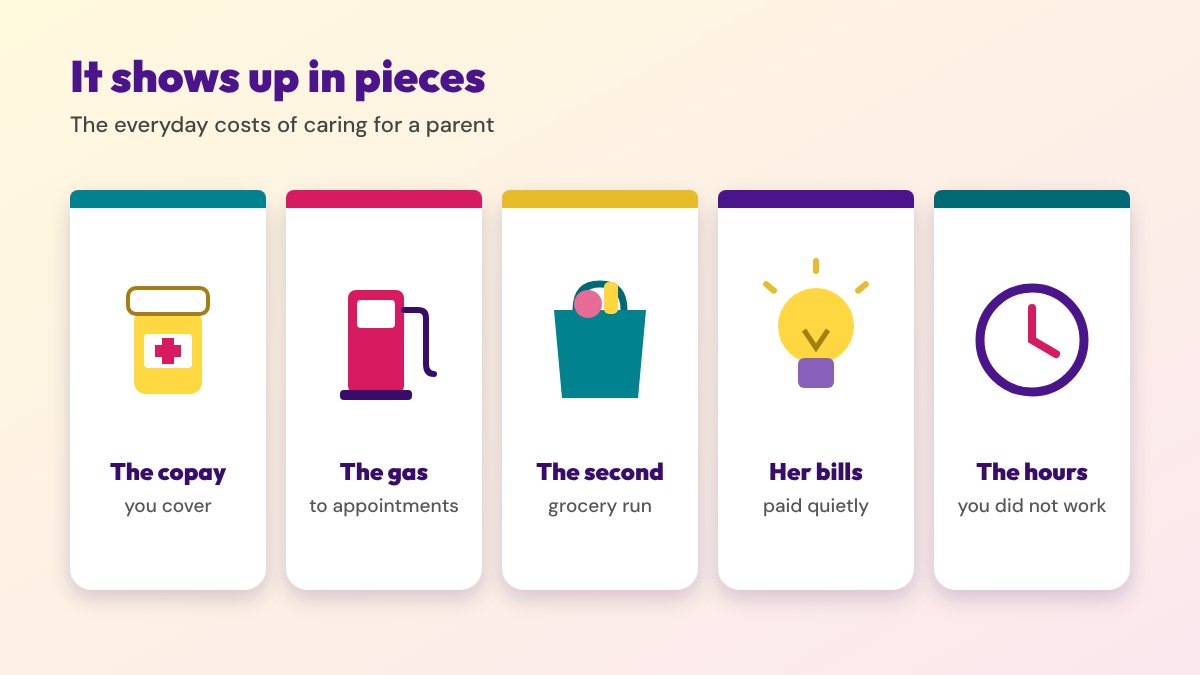
The copay you cover because the pharmacy line is long and Mom is tired.
The gas to appointments, sometimes across town, sometimes across the state.
The second grocery run, because her fridge needs filling too.
The phone plan, the streaming account, the late fee you quietly paid so the lights stay on at her house.
The hours you did not work because someone had to be at the hospital.
A national AARP study found that family caregivers spent an average of $7,242 a year of their own money on caregiving. That was about a quarter of their income. And that study is from 2021, before the price increases of the last few years, so the number today is likely higher.
Caregiving rarely arrives as one big bill. It shows up in pieces, and each piece seems too small to plan for.
The Guilt Line Item in a Caregiver’s Budget
There is a cost that never shows up on a bank statement. It is the feeling that every dollar you spend on yourself is a dollar you took from someone who needs you.
That feeling has a way of turning into decisions. Skipping your own doctor visit. Putting off the car repair. Pausing what you were setting aside for retirement because right now feels more urgent than later. You already know later is coming. You are just one person standing between two generations, trying to hold both.
That is what love looks like when it is measured in dollars and hours.
Giving Caregiving Its Own Line in the Budget
The money tends to feel more manageable once it has a name. Not a lecture, just a line. Caregiving can have its own line in a budget, so the copays and grocery runs stop feeling like mystery leaks and start looking like what they are: a real expense of a real season of life.
It is also worth checking whether your parent qualifies for help nobody thought to look for. There are programs for medications, meals, rides to appointments, and utility bills that go unused every year simply because families do not know they exist.
Where to Find Help Caring for an Aging Parent
Not everyone has a sibling to call. Some women are only children. Some have siblings who live far away, are stretched thin themselves, or are simply not in a position to help. If that is you, the weight can feel like it belongs to you alone.
It does not have to be all yours. Help can come from places that are easy to overlook:
Your parent’s own resources. Benefits, savings, insurance, or programs they qualify for that can cover some of what you have been paying out of pocket.
Your local Area Agency on Aging. There is one serving every part of the country. They can connect you with meals, transportation, in-home help, and respite care so you get a break.
The people already around you. A cousin who handles the bills online. A neighbor who can do Tuesday pickups. A church member, a friend, a family friend who has offered and meant it.
Siblings, if you have them. A simple running list of what was spent and the hours given, shared so everyone is looking at the same picture. It is a lot easier to ask “could you cover the pharmacy each month?” when the pharmacy total is right there.
Help does not always come back as money. Sometimes it is someone taking one appointment a week off your plate. That counts too.
It does not have to be all yours.
You Are Allowed to Be in This Picture Too
The in-between years can last a long time. Your kids will need you, your parent will need you, and so will the woman you will be in twenty years. Making room for her, even a small amount, is part of taking care of everyone.
Keep Reading
Resources
Eldercare Locator A free service from the U.S. Administration for Community Living that connects families with local help for older adults, including your local Area Agency on Aging, meals, transportation, in-home care, and caregiver support. You can also call or text 1-800-677-1116.
BenefitsCheckUp Answer a few questions to see programs an older adult may qualify for, including help paying for medicine, food, utilities, and health care.
Sources: Pew Research Center, More than half of Americans in their 40s are sandwiched between an aging parent and their own children, August 2026. AARP and National Alliance for Caregiving, Caregiving in the US 2025, July 2025. AARP, Caregiving Out-of-Pocket Costs Study, June 2021.