
Before a single holiday ad has run, Americans are already carrying $1.26 trillion on their credit cards. That is the total from the second quarter of 2026, according to the Federal Reserve Bank of New York. It grew by $21 billion in just three months.
That number was measured in the spring and early summer. It does not include back-to-school, the fall car repair, or anything with a bow on it. And it lands at a time when card interest rates sit above 22 percent.
$1.26T
on credit cards
U.S. total, Q2 2026
22.15%
average card interest
accounts charged interest
45%
of cardholders
carried a balance in the past year
If your own balance has crept up this year, you are in very large company. Nearly half of people with a credit card carried an unpaid balance at least once in the past 12 months, according to the Federal Reserve. This is not a small group of people making careless choices. It is how a lot of households are getting by.
How Holiday Credit Card Debt Creeps Up, Starting in October
Holiday spending feels like a December problem. It is not. It starts now. Halloween costumes and candy. Early “best price of the year” sales. Travel booked early because waiting costs more. Thanksgiving groceries. Each one makes sense on its own.
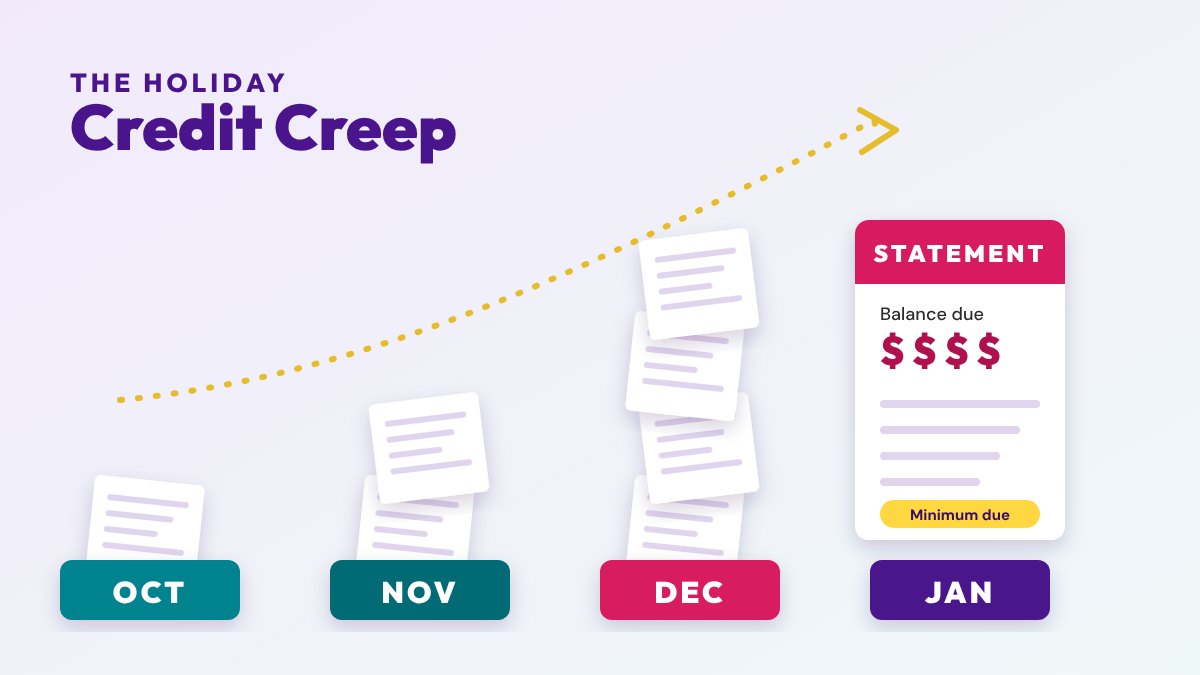
What makes the season so heavy is the quiet, gradual pile-up. A few “reasonable” credit card purchases spread over several weeks seem harmless. Some lenders even offer to let you skip a payment over the holidays, and pay-later options at checkout push the bill into the new year.
Then January rolls around. And all of those “reasonable” purchases hit you like a ton of bricks.
The holiday commercials stop on December 26. The payments do not.
What 22 Percent Credit Card Interest Actually Costs You
Interest rates are easy to skim past, so here is the plain version. The Federal Reserve reports that the average interest rate on credit card accounts that are charged interest was 22.15 percent in the second quarter of 2026.
$1,000 balance
about $18
in interest every month
$3,000 balance
about $55
in interest every month
$5,000 balance
about $92
in interest every month
On a $1,000 balance, that works out to roughly $18 in interest every month the balance goes unpaid. On $3,000, it is roughly $55 a month. That money does not buy anything. It is the cost of carrying the balance forward, and it comes back every single month until the balance comes down.
The math, if you want to check it. Divide the yearly rate by 12 to get a monthly rate. 22.15 percent divided by 12 is about 1.85 percent. Multiply that by the balance. A $1,000 balance times 1.85 percent is about $18.46. Card issuers calculate interest daily, so your statement may be a little different, but this gets you close.
When the Credit Card Becomes the Emergency Fund
Here is a number worth sitting with. Only 30 percent of Americans say they could pay for a $1,000 emergency out of their savings, according to Bankrate’s 2026 Emergency Savings Report. That means 7 in 10 could not. And 60 percent say they are uncomfortable with how much they have set aside for emergencies.
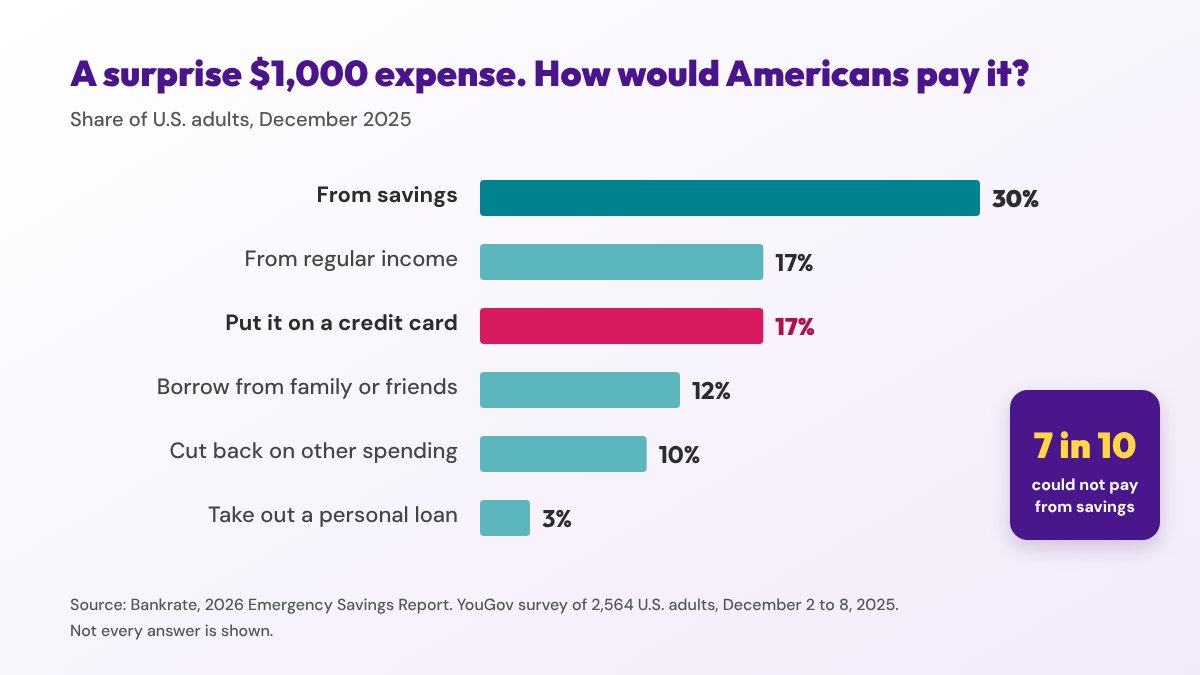
So what happens instead? Seventeen percent said they would put it on a credit card. Others would borrow from family or friends, cut back somewhere else, or take out a loan.
It is not only the big emergencies, either. When the Federal Reserve asked adults about a surprise $400 expense, 37 percent said they could not cover it with cash or savings alone. A flat tire. A vet visit. A cracked phone screen. And the holidays get added right on top.
When there is no cushion, the card becomes the cushion. That is not a character flaw. That is what happens when prices rise faster than paychecks and the bills still have to get paid.
The Minimum Payment Box on Your Statement
Every credit card statement has a small box that is easy to scroll right past. It is called the minimum payment warning, and federal law requires it. It shows how long it would take to pay off your current balance if you only made the minimum payment each month, and how much you would pay in total.
For a lot of people, that box holds the most surprising number on the page. A balance that feels like a few months of catching up can stretch into years when only the minimum goes in, because most of each minimum payment goes to interest first. The box also shows what it would take to pay the balance off in three years, which gives you a second, much shorter timeline to compare.
You do not have to do anything with that number. But it is worth knowing it is there. Sometimes seeing it in black and white is all it takes to look at the next purchase a little differently.
The Warning Sign Worth Watching
The New York Fed also tracks how many card balances fall seriously behind, meaning 90 days or more past due. In the second quarter of 2026, about 6.97 percent of credit card balances moved into serious delinquency on a yearly basis, a little higher than the 6.93 percent a year earlier.
You will not find a holiday commercial advising you to spend with caution. Behind each of those percentage points are real people juggling minimum payments, late fees, and phone calls they would rather not answer. If you are one of them, you are not alone, and there is help that does not cost a thing.
What You Can Look Into Before the Holidays
Every balance on one page. Each card, its balance, and its interest rate, written down in one place. It is not fun. It is also usually less scary on paper than it is in your head.
A holiday number, set before the sales start. When the total is decided ahead of time, each purchase becomes a choice instead of a reaction.
A call to your card issuer. A lot of issuers have hardship programs that can lower a rate or pause fees for a while. They are rarely advertised. Asking costs nothing.
A nonprofit credit counselor. Nonprofit credit counseling agencies can walk through your options without trying to sell you a loan.
The Bottom Line
A $1.26 trillion headline can feel a world away from your kitchen table. Your own balance is the number that matters, and it is also the one you can actually see, plan around, and bring down over time. October is a calm moment to look at it, before the season gets loud.
Keep Reading
Resources
Consumer Financial Protection Bureau: Credit cards Plain-language explanations of interest, fees, and your rights as a cardholder, including what to do if you are struggling to keep up with payments.
National Foundation for Credit Counseling A network of nonprofit credit counseling agencies that can talk through your situation and options, including debt management plans.
Sources: Federal Reserve Bank of New York, Quarterly Report on Household Debt and Credit, Q2 2026, August 2026. Federal Reserve Board, G.19 Consumer Credit, September 2026. Federal Reserve Board, Economic Well-Being of U.S. Households in 2025, May 2026. Bankrate, 2026 Emergency Savings Report, survey conducted by YouGov, December 2025.